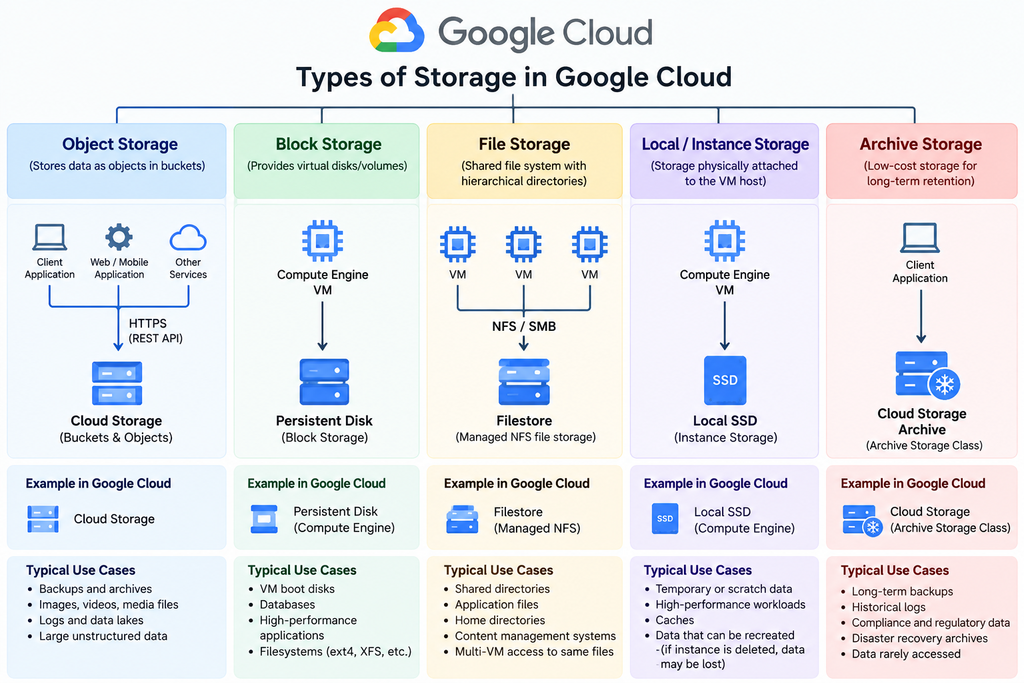
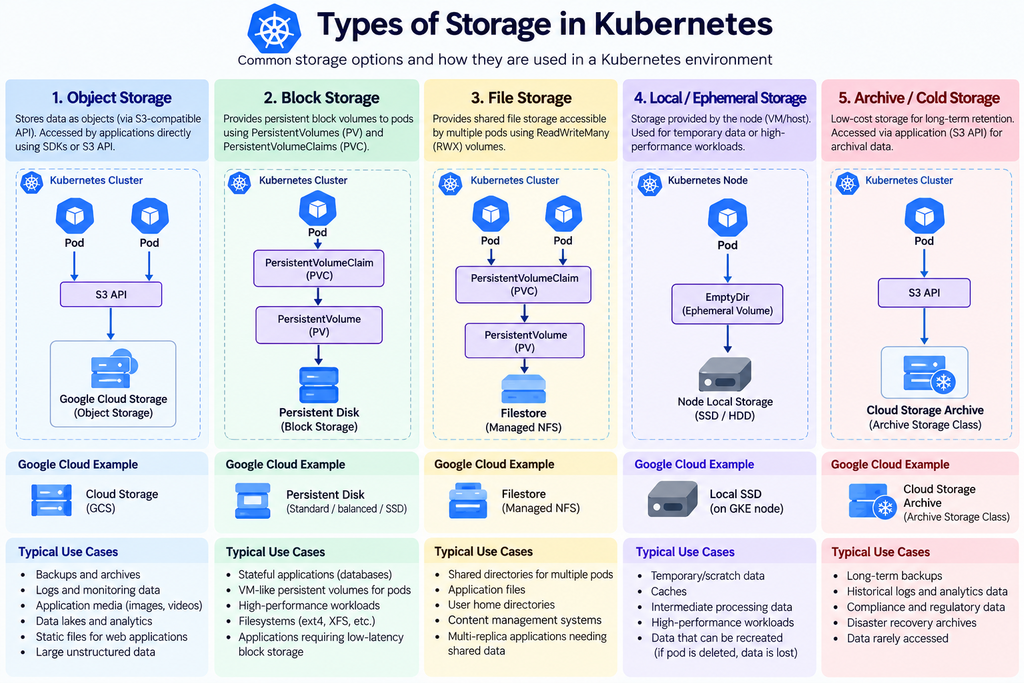
What is Storage? Storage is the hardware or service used to save, retain, and retrieve digital data, either temporarily or permanently.
Main Storage Types
Block Storage – Data stored in fixed-size blocks; ideal for disks, VMs, and databases.
File Storage – Data organized as files and folders; commonly accessed through NFS or SMB.
Object Storage – Data stored as objects with metadata; ideal for backups, media, logs, and cloud-scale data.
Local/Ephemeral Storage – Fast storage attached to a server; often used for temporary data.
Archive Storage – Low-cost storage for long-term, rarely accessed data.
Different storage types provide different levels of performance, persistence, scalability, sharing, availability, and cost. Choosing the right type ensures applications get the required speed, reliability, data protection, and cost efficiency.
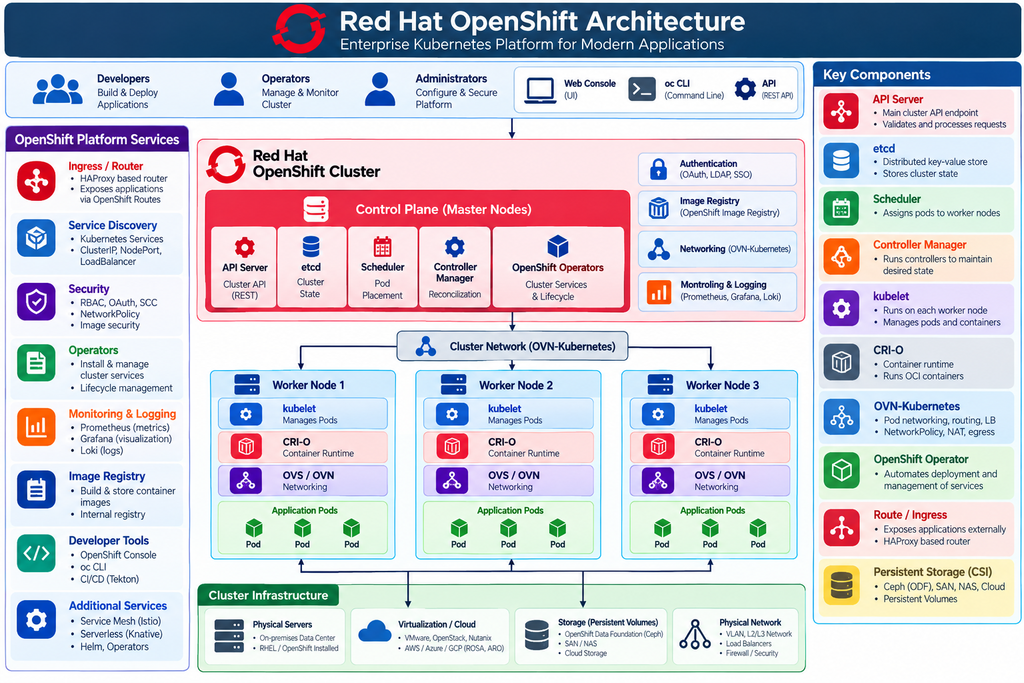
Red Hat OpenShift is an enterprise container platform built on Kubernetes. It provides an integrated environment for deploying, managing, scaling, and securing containerized applications across physical, virtual, and cloud infrastructure.
Main architectural components:
Control Plane – Manages the cluster through the API Server, etcd, Scheduler, Controller Manager, and OpenShift Operators.
Worker Nodes – Run application pods using kubelet and the CRI-O container runtime.
Networking – OVN-Kubernetes provides pod networking, routing, load balancing, NetworkPolicy, and ingress/egress connectivity.
Platform Services – Includes Routes/Ingress, authentication, image registry, monitoring, logging, Operators, and developer tools.
Storage – CSI-based persistent storage can integrate with Ceph/ODF, SAN, NAS, and cloud storage.
Infrastructure – OpenShift can run on bare metal, virtualization platforms, private clouds, and public clouds.
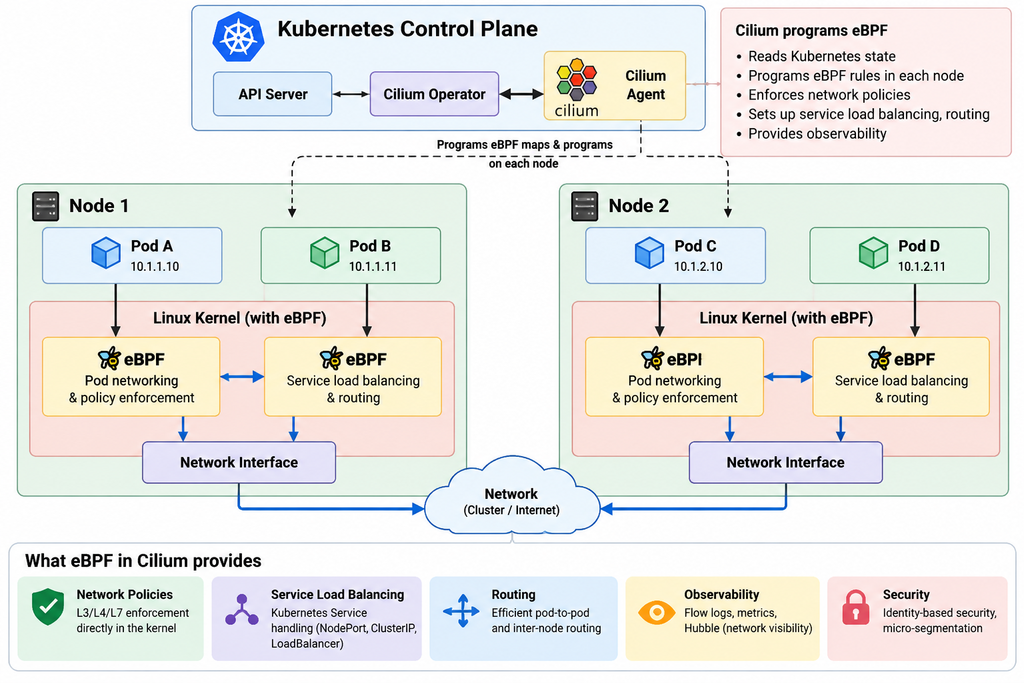
eBPF (extended Berkeley Packet Filter) is a Linux kernel technology that allows small, secure programs to run directly inside the kernel without modifying kernel source code.
In Cilium, eBPF is mainly used for:
High-performance networking between Kubernetes pods and nodes
Network policy & security enforcement
Service load balancing and routing
Traffic monitoring & observability with Hubble
Reducing or replacing traditional iptables-based packet processing
In short: eBPF gives Cilium a programmable, efficient way to control and observe network traffic directly inside the Linux kernel.
In simple terms:
Pod → eBPF (Cilium) → Network → eBPF → Pod
eBPF allows Cilium to provide things such as network policies, load balancing, routing, service handling, and network visibility, often without relying heavily on traditional iptables.
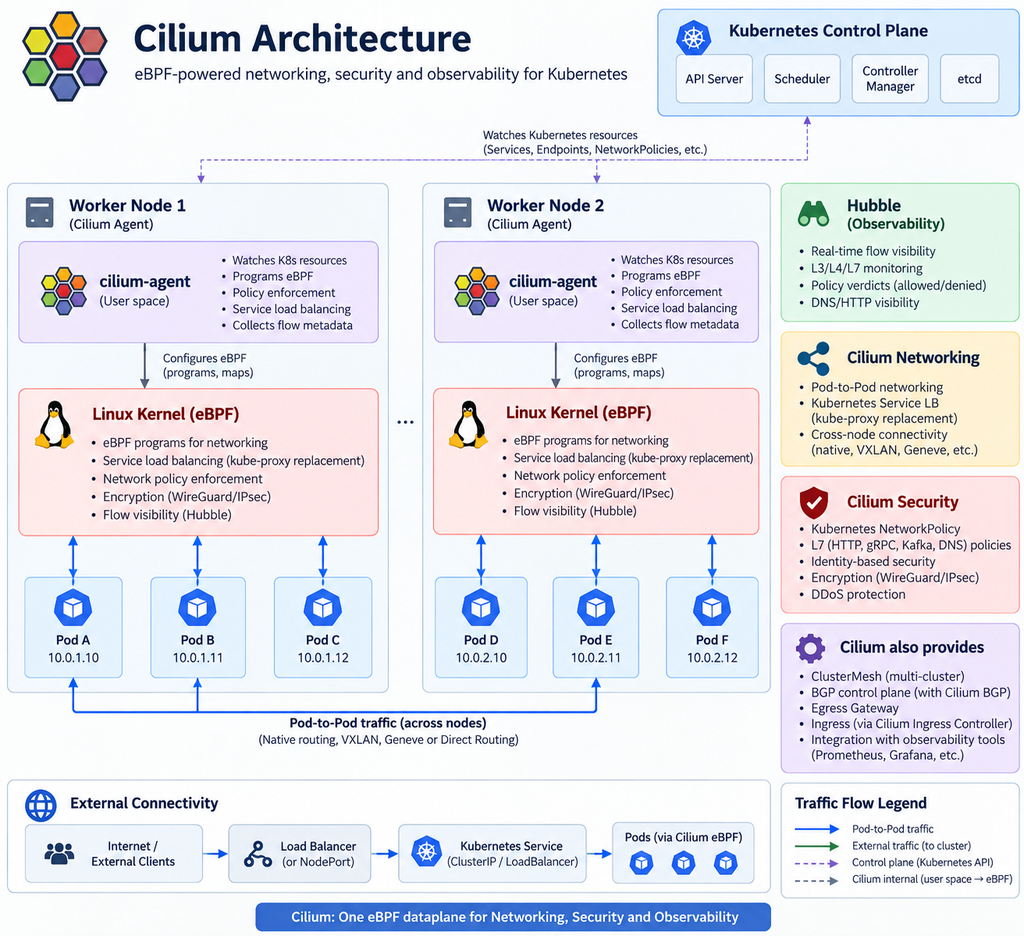
What is Cilium? Cilium is an open-source CNI (Container Network Interface) for Kubernetes. It uses Linux eBPF technology to provide high-performance networking, security, load balancing, and observability.
Where is it used? Cilium is commonly used in Kubernetes environments for Pod-to-Pod networking, NetworkPolicy enforcement, Service load balancing, multi-cluster connectivity, and network monitoring. It is especially useful in large-scale cloud-native environments where performance, security, and visibility are important.
Key features: eBPF-based networking, L3/L4/L7 security policies, kube-proxy replacement, encryption with WireGuard/IPsec, and network observability through Hubble.
Alternatives:Calico is a popular feature-rich CNI with strong network-policy capabilities; Flannel is a simpler option mainly focused on Pod networking; Antrea is a Kubernetes-native networking and security solution based on Open vSwitch; and Kube-router provides networking and policy with a relatively lightweight architecture.
In short: Cilium = Kubernetes networking + security + observability, powered by eBPF.
Based on the LFS258 topics, here is a 12-week Sunday Kubernetes Fundamentals learning plan. I’ve arranged it so each week builds on the previous one and includes theory, commands, a diagram topic, and a practical lab.
Week
Main Topic
Key Things to Learn
Commands / Lab Focus
1
Kubernetes Foundations
Containers vs Kubernetes, cluster concepts, control plane vs worker nodes
kubectl version, kubectl cluster-info, kubectl get nodes
2
Kubernetes Architecture
API Server, Scheduler, Controller Manager, etcd, kubelet, kube-proxy
kubectl get nodes
kubectl get pods -A
kubectl get svc
kubectl get ingress
kubectl get pv,pvc
kubectl get roles,rolebindings
Finish with a practical challenge: deploy an application with Deployment → Service → Ingress → PVC, intentionally introduce two faults, then troubleshoot them.
Recommended Sunday session structure
Since you already have a regular Kubernetes & Cloud Native learning session, a compact format can work well:
10 min — Concept → 5 min — Architecture diagram → 10 min — commands/demo → 5 min — troubleshooting/question
For deeper personal study, spend another 60–90 minutes during the week reproducing the lab yourself. The biggest improvement will come from typing the commands rather than only reading them.
After these 12 weeks, the natural next step is CKA-focused practice, especially timed exercises around troubleshooting, networking, storage, scheduling, RBAC, cluster maintenance, and kubectl speed.
Ceph is not an acronym, so there is no official expansion like “C.E.P.H.”
The name Ceph comes from “cephalopod”—animals such as an octopus or squid. The idea fits Ceph because it can spread and manage data across many storage nodes, somewhat like many arms working together.
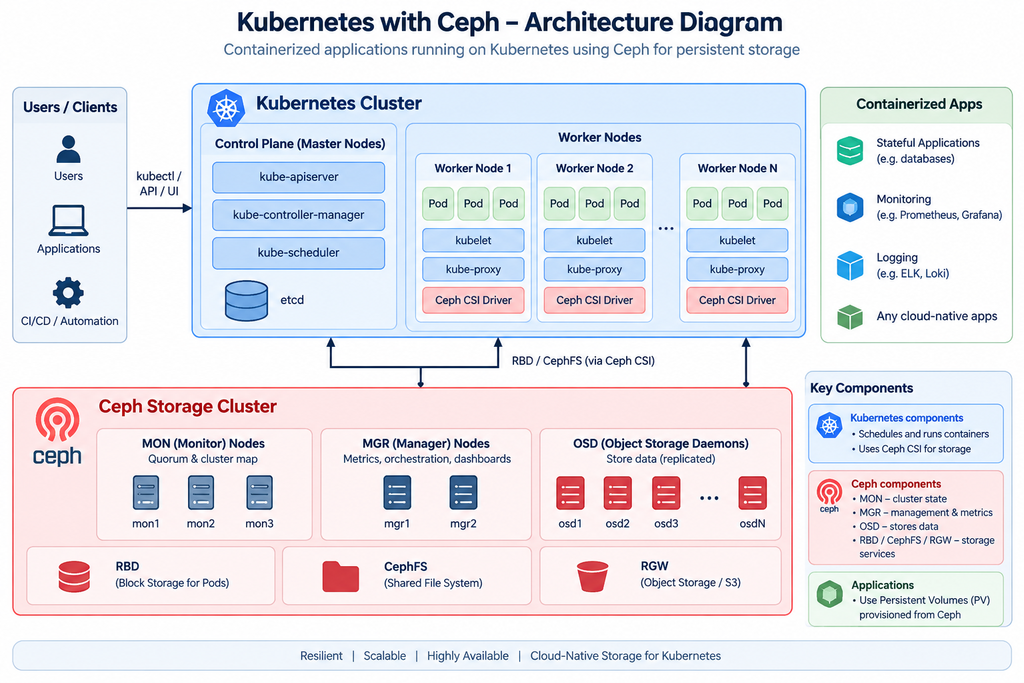
Kubernetes handles container orchestration, scheduling, networking, and application lifecycle management, while Ceph provides the storage layer. Ceph MON, MGR, and OSD components work together to maintain cluster health, manage the storage environment, replicate data, and provide resilient persistent storage to Kubernetes applications.
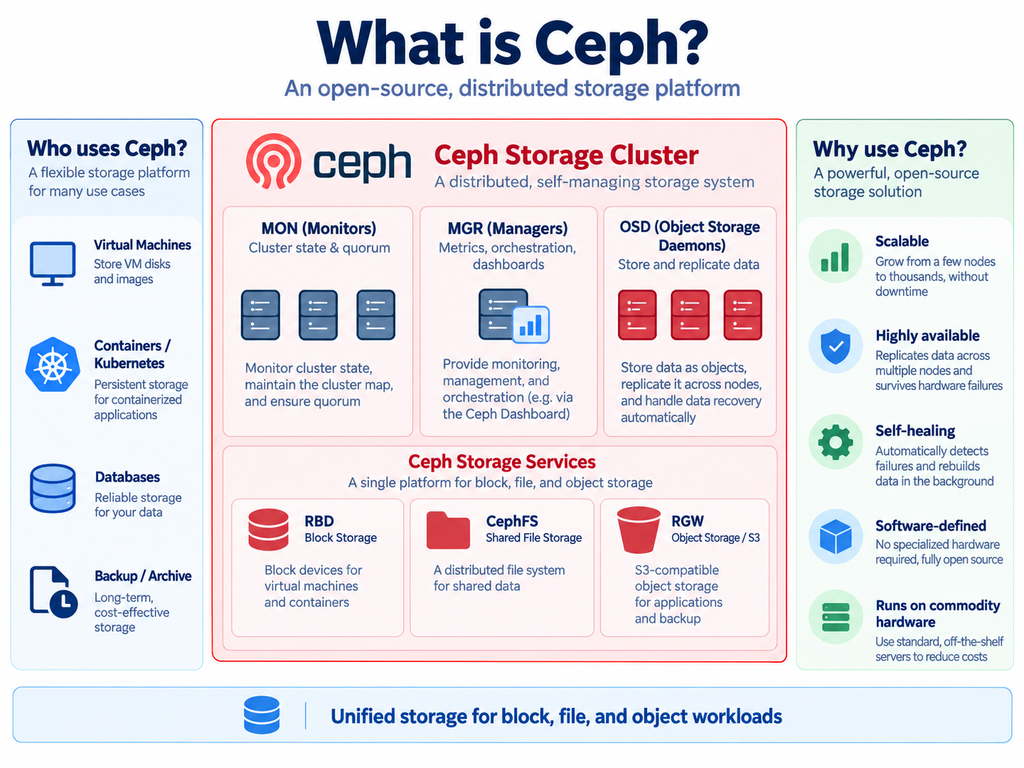
Ceph combines multiple storage servers into one distributed storage platform. It can provide RBD block storage for virtual machines and Kubernetes, CephFS for shared file storage, and RGW for S3-compatible object storage. Because data is distributed and replicated across multiple OSDs, Ceph can automatically recover from disk or server failures while keeping applications running.
Kubernetes and Ceph provide a scalable, highly available, cloud-native platform for running stateful applications such as databases, monitoring systems, logging platforms, and other enterprise workloads.