Task 1: Understand Kubernetes architecture
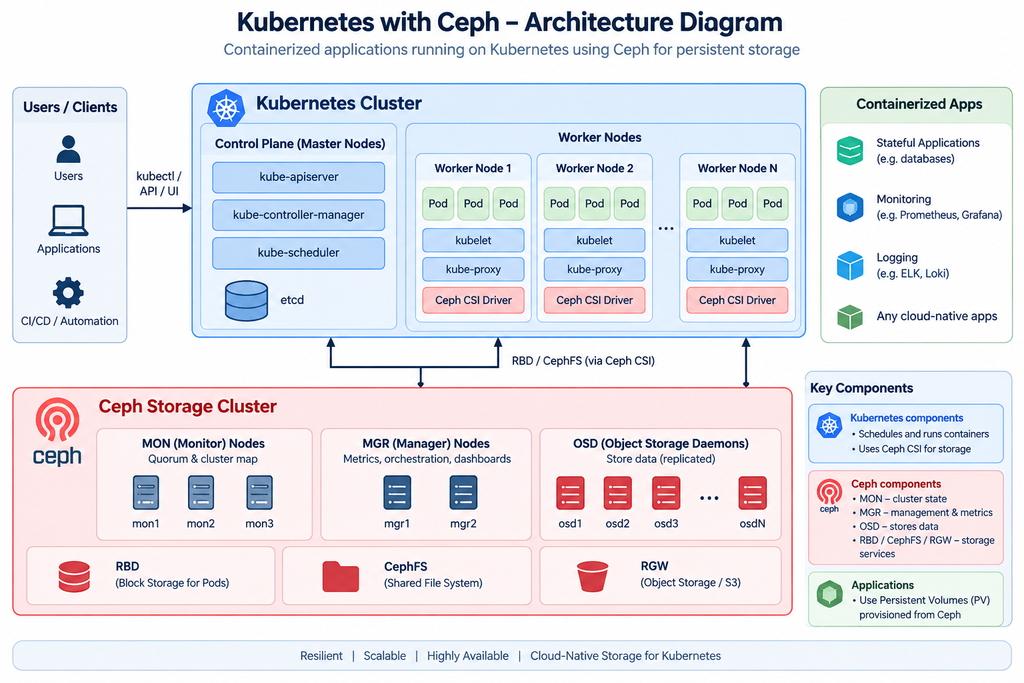
Objective: Identify control-plane components, worker components, and their responsibilities.
Show all nodes
kubectl get nodes -o wide
View system components
kubectl get pods -n kube-system -o wide
Inspect control-plane components
kubectl get pods -n kube-system | grep -E
‘apiserver|scheduler|controller|etcd’
Check API server health
kubectl get –raw=’/readyz?verbose’
View cluster information
kubectl cluster-info
Expected: All three nodes are Ready. API server, scheduler, controller-manager, and etcd are healthy.
Task 2: Cluster and node health checks
Objective: Learn to inspect node conditions, capacity, and cluster resources.
kubectl get nodes
kubectl describe node k8sw1
Check CPU and memory usage
kubectl top nodes
kubectl top pods -A
List cluster resources
kubectl get all -A
Show node resource allocation
kubectl describe nodes | grep -A 8 “Allocated resources”
Check recent events
kubectl get events -A –sort-by=.lastTimestamp
Exercise: Identify which worker has the highest CPU usage and check whether any pod is failing.
Task 3: Explore kubeadm and cluster configuration
Objective: Understand how kubeadm bootstraps Kubernetes clusters.
Run on the control-plane node:
Check kubeadm version
kubeadm version
Inspect kubeadm cluster configuration
kubectl -n kube-system get cm kubeadm-config -o yaml
Inspect kubelet configuration
kubectl -n kube-system get cm kubelet-config -o yaml
Check kubelet service
sudo systemctl status kubelet
Inspect static pod manifests
sudo ls -l /etc/kubernetes/manifests/
Inspect Kubernetes certificates
sudo kubeadm certs check-expiration
Exercise: Find the API server endpoint, Pod CIDR, and Kubernetes version.
Task 4: Kubernetes networking
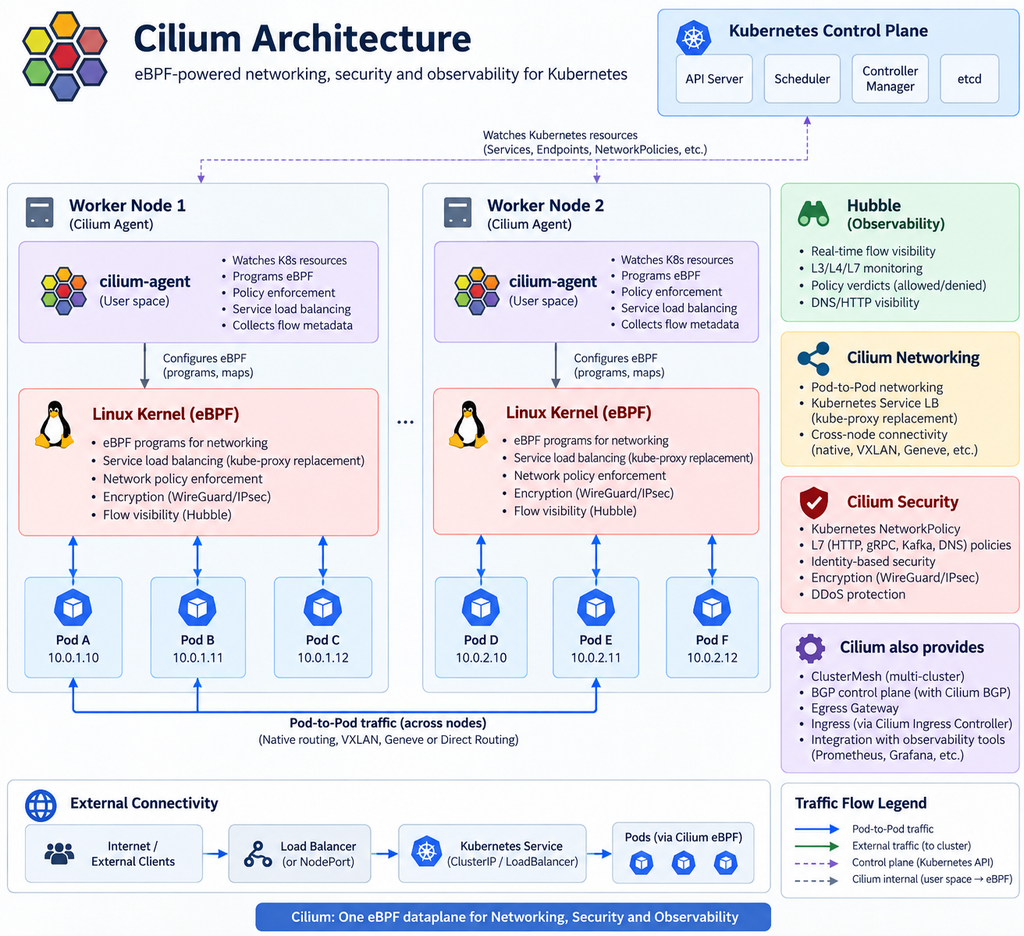
Objective: Understand Pod networking, Services, DNS, and CNI.
Check Pod IP addresses
kubectl get pods -A -o wide
Check Services
kubectl get svc -A
Inspect Flannel CNI
kubectl get daemonset -n kube-flannel
kubectl get pods -n kube-flannel -o wide
Check CoreDNS
kubectl get pods -n kube-system -l k8s-app=kube-dns
Test cluster DNS
kubectl run dns-test
–image=busybox:1.36
–restart=Never
–command — sleep 3600
kubectl exec dns-test — nslookup kubernetes.default.svc.cluster.local
Cleanup
kubectl delete pod dns-test
Exercise: Verify that CoreDNS resolves Kubernetes Service names.
Task 5: Deploy and manage an application
Objective: Practice Deployments, replicas, scaling, and rollout management.
Create Deployment
kubectl create deployment web –image=nginx:stable
Scale to three replicas
kubectl scale deployment web –replicas=3
Expose application internally
kubectl expose deployment web
–port=80 –target-port=80
Inspect application
kubectl get deployments,pods,svc -o wide
Update container image
kubectl set image deployment/web nginx=nginx:alpine
Monitor rollout
kubectl rollout status deployment/web
Check rollout history
kubectl rollout history deployment/web
Roll back
kubectl rollout undo deployment/web
Exercise: Confirm that three replicas are running and distributed across available nodes.
Task 6: Node maintenance
Objective: Safely remove workloads from a worker node for maintenance.
Mark worker unschedulable
kubectl cordon k8sw1
Drain workloads
kubectl drain k8sw1
–ignore-daemonsets
–delete-emptydir-data
Check node state
kubectl get nodes
Re-enable scheduling
kubectl uncordon k8sw1
Verify node
kubectl describe node k8sw1
Important: drain can disrupt applications, and --delete-emptydir-data permits deletion of temporary Pod data. Practice only with disposable workloads.
Exercise: Explain the difference between cordon, drain, and uncordon.
Task 7: Monitoring and troubleshooting
Objective: Identify failed workloads and troubleshoot Kubernetes components.
Find pods not Running or Succeeded
kubectl get pods -A
–field-selector=status.phase!=Running,status.phase!=Succeeded
Check deployment health
kubectl get deployments -A
Check daemonsets
kubectl get daemonsets -A
Inspect a pod
kubectl describe pod -n
Inspect container logs
kubectl logs -n
Previous container logs
kubectl logs -n –previous
Inspect kubelet logs on a node
sudo journalctl -u kubelet -n 100 –no-pager
Exercise: Create a pod with an invalid image and diagnose the ImagePullBackOff error.
Task 8: RBAC and Service Accounts
Objective: Implement least-privilege API access.
Create namespace
kubectl create namespace cka-lab
Create ServiceAccount
kubectl create serviceaccount cka-reader -n cka-lab
Create Role
kubectl create role pod-reader
–verb=get,list,watch
–resource=pods
-n cka-lab
Bind Role to ServiceAccount
kubectl create rolebinding pod-reader-binding
–role=pod-reader
–serviceaccount=cka-lab:cka-reader
-n cka-lab
Test authorization
kubectl auth can-i list pods
–as=system:serviceaccount:cka-lab:cka-reader
-n cka-lab
Test denied action
kubectl auth can-i delete pods
–as=system:serviceaccount:cka-lab:cka-reader
-n cka-lab
Expected: Listing pods returns yes; deleting pods returns no.
Task 9: Kubernetes cluster upgrades
Objective: Understand the kubeadm upgrade workflow.
For a practice lab, begin with read-only checks:
Check current versions
kubectl version
kubeadm version
kubelet –version
Check node versions
kubectl get nodes -o wide
Inspect upgrade plan on control-plane
sudo kubeadm upgrade plan
Upgrade workflow to study:
Do not execute an upgrade without checking version compatibility, package repositories, and the official version-specific procedure.
Task 10: High availability and etcd
Objective: Understand etcd, control-plane redundancy, and recovery.
Check etcd pod
kubectl get pods -n kube-system | grep etcd
Inspect etcd logs
kubectl logs -n kube-system etcd-k8sm –tail=50
Inspect etcd static pod configuration
sudo cat /etc/kubernetes/manifests/etcd.yaml
Check control-plane nodes
kubectl get nodes
-l node-role.kubernetes.io/control-plane
Inspect API server endpoints
kubectl get endpoints kubernetes -n default
Exercise: Explain why a single control-plane cluster is not highly available and why a three-member etcd cluster can tolerate one member failure.